Buy It or Skip It: What to Buy (and Skip) in the Target Toy Aisle
Shopping the Target toy aisle doesn’t have to end with buyer’s remorse. In this first post of my Buy It or Skip It series, I’m sharing the toy-buying rules I follow every time I shop, from avoiding battery-operated, overstimulating toys to choosing open-ended toys that encourage creativity, imaginative play, and STEM learning. These are the simple guidelines that have helped us spend less, reduce toy clutter, and build a toy collection my girls actually play with year after year.

This blog post may contain affiliate links. When you make a purchase through these links, I may earn a small commission, at no additional cost to you. I only recommend products that I genuinely believe can benefit you and your family! Your support helps maintain and improve all things A Pop of You. Thanks so much!
Buy It or Skip It: Helping You Buy Better, Not More
Walking through the toy aisle (or scrolling Amazon after the kids go to bed) can feel like an impossible task. Every toy promises to build creativity, encourage learning, or become your child’s new favorite. But if you’ve ever spent good money on a toy that was abandoned by lunchtime, you know the reality doesn’t always match the marketing.
That’s exactly why I started my Buy It or Skip It series.
As a former teacher, homeschool mom, and someone who’s intentionally simplified our home over the years, I’ve learned that more toys don’t necessarily create better play. In fact, I’ve found the opposite is often true. A thoughtfully chosen collection of toys that truly earn their place in your home almost always leads to more creativity, deeper play, less clutter, and fewer regrets.
In this series, I’m sharing the toys that have stood the test of time in our house, along with the ones I personally wouldn’t buy again. Every recommendation is based on real-life experience, not what’s trending online or what’s sitting at the top of a bestseller list. I look for toys that encourage open-ended play, grow alongside children, support learning and imagination, and continue getting pulled off the shelf months or even years later.
You’ll also see me recommend skipping toys that are overpriced, overly complicated, take up unnecessary space, or lose their appeal almost as quickly as they’re unboxed. Because sometimes the best purchase is the one you never make.
My goal isn’t to convince you to buy more toys. It’s to help you buy better toys. The kind that save you money in the long run, reduce toy overwhelm, support meaningful play, and make your home feel a little calmer in the process.
Each post in this series focuses on a different category of toys to help you make confident, informed decisions before you click “Add to Cart.” I hope these honest recommendations help you build a toy collection your kids truly love, and one you won’t regret bringing into your home.
What I’m Looking for in the Target Toy Aisle: PART 1
People ask me all the time how I decide whether a toy is worth buying, and honestly, I’ve become pretty predictable. After years of watching what my girls actually play with (and what quietly ends up in the donation box), I’ve developed a few simple guidelines that help me shop with a lot more confidence. They’re not hard-and-fast rules, but they’ve saved us money, reduced clutter, and helped us build a toy collection that gets played with long after the excitement of opening the box wears off.
Rule #1: No Batteries
If you’ve followed me for any length of time, this one probably won’t surprise you. My number one toy rule is simple: no batteries.
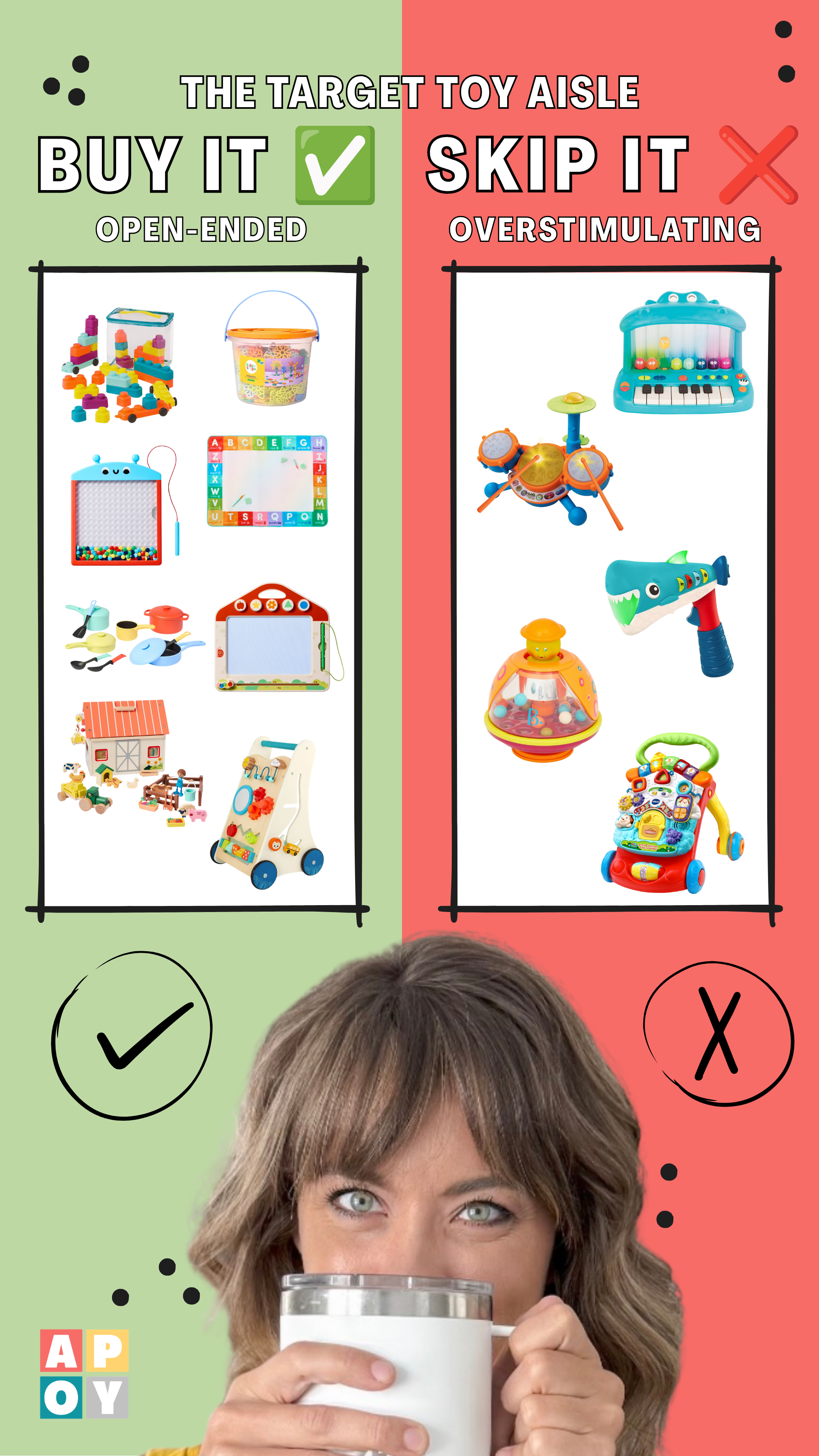
When a toy advertises that it lights up, sings songs, talks, or has dozens of buttons to push, it’s almost always a skip for me. It’s not because those toys are inherently bad, but because I’ve found they often do the entertaining for the child instead of encouraging the child to create the fun themselves. They can also be loud, overstimulating, and surprisingly limited once the novelty wears off.
Instead, I look for toys that simply provide the materials for play and let my kids take it from there. The toys that have lasted the longest in our home are almost always the quiet ones. They don’t need batteries to keep my girls engaged because their imaginations are doing all the work.
Beware of “Future Donations”
Every parent has bought one before. It’s the toy your child absolutely has to have while you’re standing in the Target toy aisle. They play with it nonstop that afternoon, maybe even the next day, and then it quietly disappears into the bottom of the toy bin until it’s eventually donated.
I call those toys future donations.
Before I buy anything, I try to picture whether my kids will still be reaching for it six months from now. If I honestly don’t think they will, I usually leave it on the shelf. Buying fewer toys that stand the test of time has been far more worthwhile than constantly chasing the newest trend.
Choose Interactive Toys Over Performing Toys
One of the biggest changes I’ve made when shopping is choosing interactive toys instead of performing toys.
Performing toys do most of the work. They light up, sing songs, demonstrate, tell children what button to press next, and often dictate exactly how they’re supposed to be played with. Interactive toys, on the other hand, require children to participate. They provide the starting point, but it’s up to the child to create the story.
A foldable wooden barn is one of my favorite examples. On its own, it’s incredibly simple. But in our house, it’s been a farm, a veterinary clinic, a horse stable, a grocery store, and even a family home for tiny animal figurines. If I could go back and redo one baby purchase, I’d also skip the flashy, battery-operated walker we bought and choose a simple wooden baby walker instead. We had the popular VTech one that lights up, plays music, and talks, but knowing what I know now, I would have much rather had a walker that could continue growing with my girls long after they learned to walk.
Those toys continue to stay relevant because they change with the child instead of expecting the child to play one predetermined way.
Prioritize Open-Ended, Imaginative Play
You’ll probably notice a pattern in many of my favorite toy recommendations: they’re all incredibly open-ended.
A simple pots and pans set becomes a restaurant one day and a campsite the next. A water doodle mat turns into an art studio, a handwriting practice station, or a place to play tic-tac-toe. A magnetic drawing board gets used for everything from playing school to making treasure maps. Magnetic tiles become castles, dollhouses, marble runs, race tracks, animal habitats, and inventions I never could have imagined myself.
None of these toys tell children exactly what to do. Instead, they give children the freedom to create their own ideas, solve their own problems, and direct their own play. That’s one of the biggest reasons they continue getting pulled off the shelf year after year.
Look for Toys That Build STEM Skills Naturally
I also love toys that naturally build STEM skills without feeling like a lesson.
Building discs are one of my favorites because they’re incredibly versatile. As children connect pieces together, they’re experimenting with engineering, balance, spatial reasoning, problem-solving, and creative thinking without even realizing it. They’re simply building, testing ideas, making adjustments, and trying again.
Those are the kinds of educational toys I get excited about because the learning happens naturally through play instead of feeling forced.
Accuracy Matters More Than Aesthetics
I’ll admit it, I appreciate a beautiful toy as much as anyone. But I’ve learned not to let aesthetics be the deciding factor.
Especially when it comes to educational toys, accuracy is far more important than whether something looks cute sitting on a shelf. I’d much rather recommend a toy that’s well-designed, developmentally appropriate, and correctly teaches concepts than one that’s trendy but sacrifices function for appearance.
Children learn from everything we put in front of them. If a toy is going to claim it’s educational, I want it to actually be educational.
The Bottom Line
When I’m walking through the Target toy aisle, I’m not looking for the flashiest packaging or whatever toy is currently going viral online. I’m looking for toys that encourage my kids to think, imagine, create, build, and problem-solve. The best toys don’t replace a child’s imagination, they make room for it.
That’s why you’ll see the same themes throughout this series. Fewer batteries. Fewer gimmicks. More creativity. More open-ended play. More toys that truly earn their place in your home.
Because at the end of the day, my goal isn’t to help you buy more toys. It’s to help you buy better ones.



Hey There,
I’m Katelyn!

Hi, I’m Katelyn! Join me for creative, intentional family fun and practical home management tips! Parenting is hard, but I’ve got the tools to help you create a calmer, more intentional home!
BROWSE MY
TOY RECS
resourceS
SHOP LEARNING RESOURCES




Subscribe to the empty mug club

GET OUR DAILY TO-DOS FREE!
Plus, get the latest achievable learning activities, easy recipes, storage solutions, teacher-approved toy suggestions + exclusive discounts to Becoming You learning resources straight to your inbox!

About Katelyn Collier , MAT
Katelyn Collier is a former elementary school teacher turned homeschooling mom of three and the founder of A Pop of You. She’s passionate about helping families step away from the pressure of today’s fast-paced culture and create homes filled with presence, joy, and balance. Through her resources and podcast, she shares simple, practical tools to reclaim childhood and make family life feel lighter and more intentional.
Masters DEgree in elementary education
VOICE OF BECOMING UNPOPULAR, A PODCAST COMING SOON!
CREATOR OF BECOMING YOU, A KIDS’ LEARNING RESOURCE LINE


FIND MORE INSPIRATION
Even More Achievable Ideas