Teaching Phonics: A Parent’s Guide to Helping Kids Learn to Read
Phonics doesn’t have to feel complicated. Learn what phonics is, why it matters for reading, how decoding and blending work, and how to teach phonics at home one skill at a time.

This blog post may contain affiliate links. When you make a purchase through these links, I may earn a small commission, at no additional cost to you. I only recommend products that I genuinely believe can benefit you and your family! Your support helps maintain and improve all things A Pop of You. Thanks so much!
DOWNLOAD THE PHONIC GUIDE HERE
PHONICS 101: WHAT PARENTS NEED TO KNOW ABOUT TEACHING KIDS TO READ
If words like digraph, vowel team, schwa, and r-controlled vowel make you feel like you need to go back to elementary school before you can teach your own child to read, you are definitely not alone. Phonics comes with a LOT of terminology, and when you start looking into how to teach reading, it can quickly feel like there are hundreds of rules you were somehow supposed to already know.
The good news is that you don’t need to memorize the entire English language before you begin teaching your child to read. You just need to understand the skill you’re teaching next—what it is, why it matters, and how to teach it. And that’s exactly what we’re going to do throughout this Homeschool University series.
Before we start breaking down individual phonics rules and patterns, though, I want you to understand the big picture. Because phonics isn’t really a giant collection of random rules that you and your child need to memorize. It’s a system for understanding how the sounds in our spoken language are represented in print. Once you understand how that system works, all those individual phonics lessons start to make a whole lot more sense.
That’s today’s class.
WHAT IS PHONICS?
At its simplest, phonics is the relationship between the sounds we hear in spoken language and the letters or combinations of letters that represent those sounds in print.
Your child knows spoken words long before they can read them. They can say cat, recognize the word ship when they hear it, and understand what you mean when you tell them to grab their coat. Reading requires them to learn that those spoken words can also be represented by a written code.
Phonics teaches children how that code works. They learn that the letter m can represent the /m/ sound, t can represent /t/, and two letters like sh can work together to represent /sh/. As their phonics knowledge grows, they begin learning more of the patterns and conventions that help them figure out increasingly complicated words.
This is important because learning to read isn’t simply about recognizing what a word looks like. We want children to understand how the letters in a word connect to the sounds in the word so they have a strategy for figuring out words they haven’t encountered before.
PHONEMIC AWARENESS VS. PHONICS
If you’ve spent any time researching early reading, you’ve probably heard the terms phonemic awareness and phonics. They are closely connected, but they aren’t the same skill.
The easiest way to understand the difference is to remember that phonemic awareness is all about sound, while phonics connects those sounds to print. Phonemic awareness happens without children ever needing to see a letter. If you orally give your child the sounds /c/ /a/ /t/ and they blend them together to say cat, they’re using phonemic awareness.

Now put the letters c-a-t in front of them. If your child looks at those letters, connects each one to its sound, blends the sounds together, and reads cat, they’re using phonics.
The two skills work closely together. Before children can easily connect sounds to letters, it helps if they can actually hear and work with those sounds in spoken words. That’s why phonemic awareness is such an important foundation for learning to read. Phonemic awareness helps children hear the individual sounds in words; phonics teaches them how those sounds are represented in print.
PHONICS GIVES KIDS A STRATEGY FOR READING
Imagine your child comes across a word they’ve never seen before. What are they supposed to do?
Without a reliable decoding strategy, they may look at the picture, use the first letter and guess, think about what word might make sense in the sentence, or immediately look to you for help. Those strategies might occasionally lead them to the correct word, but they don’t give children a dependable way to figure out unfamiliar words on their own.
Phonics does.
When children understand the relationships between letters and sounds, they can look at an unfamiliar word, identify the sounds represented by the letters or letter combinations, blend those sounds together, and arrive at the spoken word. This process is called decoding, and it gives children a strategy they can apply to far more than the words they’ve already memorized.
That’s a huge part of why we teach phonics. We’re not trying to teach children every word they will ever read. We’re giving them the tools they need to figure out new words for themselves.
DECODING VS. ENCODING: THE CODE WORKS BOTH WAYS
Once you understand that phonics is a code connecting sounds and print, another piece starts to make sense: children need to learn how to use that code in both directions.
When your child sees the written word cat, connects the letters to /c/ /a/ /t/, blends those sounds together, and reads cat, they are decoding. They’re moving from print to spoken language.
When you say cat and your child listens to the sounds, determines that they hear /c/ /a/ /t/, and writes c-a-t, they’re encoding. They’re moving from spoken language to print.

In simpler terms, decoding is reading and encoding is spelling. They’re different tasks, but they’re built on the same understanding of how sounds and letters work together. This is also why phonics instruction supports more than reading. As children learn more about the code, they gain tools they can use when they write and spell, too.
PHONICS IS A CODE, NOT A LIST OF RANDOM RULES
This is one of the biggest mindset shifts I want parents to make when they think about phonics. English can absolutely feel inconsistent. You teach your child one pattern, and five minutes later you encounter a word that seems determined to prove you wrong.
But phonics isn’t about handing kids an endless list of unrelated rules and asking them to memorize each one. It’s about helping them recognize recurring relationships and patterns in our written language.
Some patterns are incredibly consistent. Others have exceptions. Some work in certain positions within words. Some depend on the letters around them. As children learn more of these patterns, they build a larger and larger bank of information they can use when they encounter unfamiliar words.
The goal isn’t for your child to memorize every possible word. It’s for them to understand enough of the code that unfamiliar words become increasingly manageable.
WHAT DOES THE PHONICS PROGRESSION LOOK LIKE?
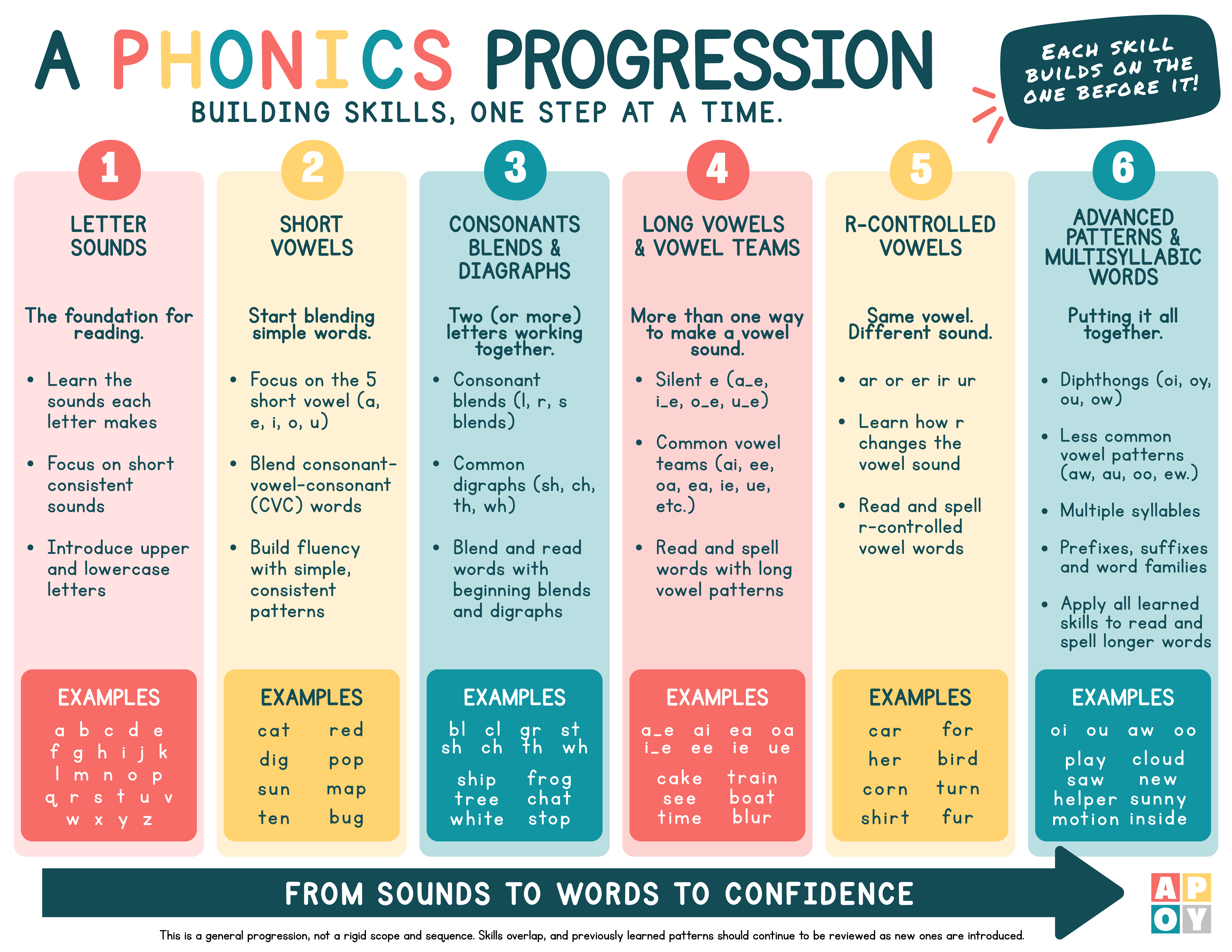
Phonics instruction builds over time. We start with simpler relationships and gradually layer in more complex patterns as children become comfortable using the skills they’ve already learned.
Early on, children begin learning basic letter-sound relationships and using those relationships to read simple words. They’ll work with short vowel sounds and learn to blend sounds together. From there, they can begin learning common consonant digraphs and blends, long-vowel patterns, vowel teams, r-controlled vowels, and increasingly complex spelling patterns. Eventually, they’ll use this knowledge to tackle longer words and multisyllabic decoding.
This isn’t meant to be a rigid checklist that every child needs to complete at exactly the same age or pace. It’s the big picture. Each new skill gives your child another piece of information they can use to read and spell words.
And this is exactly why you don’t need to know everything at once either. You don’t have to become an expert on advanced vowel patterns while your child is still learning short vowels. Learn what comes next, teach it well, give your child time to practice it, and then build from there.
PHONICS “RULES” VS. PHONICS PATTERNS
Throughout Homeschool University, you’re going to hear me use the phrase phonics rules because it’s simple, familiar language for parents. But there’s something important to understand about that word rule: not everything we teach in phonics works 100 percent of the time.
Some things really are highly reliable conventions. Others are better described as patterns, something children will see frequently enough that recognizing it gives them a useful strategy, even though there may be words that don’t behave exactly the same way.
I don’t want the exceptions to scare you away from teaching the patterns. A pattern doesn’t need to work in every single English word to be useful. We want to give children the knowledge that provides the greatest leverage and then explicitly teach the less predictable words and exceptions as they encounter them.
WHAT ACTUALLY HAPPENS WHEN A CHILD DECODES A WORD?
Sometimes “sound it out” makes reading seem like one simple skill. In reality, quite a bit is happening in your child’s brain when they decode even a short word.
Take the word ship. Your child first needs to recognize that sh is working together to represent /sh/. They need to know the sound represented by i in this word and connect p with /p/. Then they have to hold those sounds in mind and blend /sh/ /ĭ/ /p/ together until they recognize the spoken word ship.
That’s why a child can know every letter sound you ask them and still struggle to read a word. Knowing the individual sounds is only one part of the process.
BLENDING IS THE BRIDGE
One of the most common things I hear is, “My child knows all their letter sounds, but they still can’t read.” This is where blending becomes so important.
A child might look at map and correctly tell you that m says /m/, a says /ă/, and p says /p/. But if those three sounds remain separate—/m/… /ă/… /p/—they haven’t read map yet. They have to blend those sounds together into a recognizable word.
This is one reason phonemic awareness and phonics work so closely together. If blending spoken sounds is difficult without print, adding letters to the process isn’t necessarily going to make it easier. Sometimes the best thing we can do is back up, practice hearing and blending sounds orally, and then reconnect those sounds to print.
Knowing letter sounds gives your child the pieces. Blending teaches them how to put those pieces together.
WHY DOES SOUNDING OUT TAKE SO LONG?
When children are first learning to decode, reading can feel painfully slow. They may look at each letter, say each sound individually, pause, repeat the sounds, blend them together, and finally arrive at the word. Then they move to the next word and start the whole process again. That’s normal when a skill is new.
The goal isn’t for children to painstakingly sound out every word forever. With instruction and repeated practice, the process becomes increasingly automatic. Words and patterns that once required a lot of deliberate effort begin to require much less conscious attention.
Think about the difference between learning to drive and driving after years of experience. In the beginning, you’re consciously thinking about every mirror, pedal, turn, and lane change. Eventually, many of those processes happen automatically. Reading develops in a similar way. We explicitly teach children how to work through the code so that, with enough successful practice, they can recognize words more efficiently.
HOW PHONICS SUPPORTS FLUENCY AND COMPREHENSION
Phonics isn’t the same thing as reading fluency or reading comprehension, but the skills are connected.
When a child has to devote significant mental effort to figuring out every single word on a page, there isn’t as much attention available for everything else reading requires. It’s difficult to think about what a character is feeling, make a prediction, notice an important detail, or follow the meaning of a paragraph when you’re still working incredibly hard just to identify the words.
As decoding becomes more automatic, children have more attention available for phrasing, expression, and meaning. They can begin reading more smoothly because the word-reading process itself isn’t requiring quite as much effort.
That’s why phonics matters beyond simply “sounding out words.” We’re helping make word reading increasingly efficient so children can eventually focus more of their attention on what those words actually mean.
WHAT PHONICS IS NOT
Understanding phonics also means understanding what we’re not asking children to do.
Phonics isn’t memorizing hundreds of words based on what they look like. It isn’t looking at a picture and guessing the word. It isn’t reading the first letter and guessing what would make sense next. And it isn’t expecting children to simply absorb every pattern in the English language because they’ve been exposed to enough books.
Of course, pictures and context have an important place in reading. We absolutely want children thinking about whether what they read makes sense. But when the goal is identifying an unfamiliar printed word, we want them to have a strategy that actually uses the information contained in that word.
Instead of teaching children to guess, we’re teaching them to look closely at the print and use what they know about how the code works.
BUT WHAT ABOUT SIGHT WORDS?
“Sight words” can be another confusing piece of early reading because the term is often used to mean a list of common words children are expected to memorize visually.
Many high-frequency words, however, contain sounds and patterns children can decode once they’ve learned the necessary phonics skills. Others may be mostly decodable with one less predictable part that needs some extra attention.
Rather than treating every common word as a picture children need to memorize, we can help them look at what’s happening inside the word. Which parts follow patterns they already know? Which part is unexpected? What do they need to remember about this particular word?
As children’s phonics knowledge grows and they repeatedly encounter words in reading, more and more words can eventually be recognized quickly and automatically. The goal isn’t to create an enormous collection of words children can only recognize because they’ve memorized their visual shape. It’s to continue strengthening their understanding of how print represents spoken language.
WHY DON’T ALL WORDS FOLLOW THE “RULE”?
You teach a phonics rule. Your child gets it. You’re feeling pretty good about yourself. Then you open a book and immediately find a word that doesn’t seem to follow it. Welcome to English!
This doesn’t mean teaching phonics rules is pointless. It means we need to be careful about presenting every pattern as an absolute. English has developed over a very long time and has been influenced by many different languages, which means our spelling system contains both predictable patterns and less predictable words.
Our job isn’t to pretend the exceptions don’t exist. It’s to teach children the patterns that give them the most useful information, then explicitly address exceptions and less predictable words when they come up. A child doesn’t need a strategy that works perfectly for every English word in order for that strategy to be incredibly valuable.
HOW TO INTRODUCE A NEW PHONICS PATTERN
As we work through individual phonics rules in Homeschool University, the exact teaching process will change depending on the skill. But there’s a general framework you can keep coming back to:

Start by helping your child hear the sound or sound pattern you’re teaching. Then connect that sound to the letters they will see in print. Give them opportunities to physically build, change, sort, or manipulate words so they’re actively noticing what happens when letters change. Move into reading individual words containing the pattern, and then give them opportunities to find and read that same pattern in actual sentences and books.
And then, this part matters, come back to it.
We don’t want a child to successfully read ten silent-E words on Tuesday and then never encounter that skill again. Learning requires repeated opportunities to retrieve and apply previously taught information. That’s where review comes in.
PHONICS NEEDS SPIRAL REVIEW
If you’ve been following Homeschool University, you already know I’m a big fan of spiral review. Phonics is a perfect example of why it matters. Teaching a pattern once doesn’t mean a child owns it. They need opportunities to see it again in different words, recognize it without being told it’s there, use it alongside other patterns they’ve learned, and eventually apply it while reading connected text.
That means your phonics practice shouldn’t always look like, “Today we’re practicing sh, so every word has sh.” That kind of focused practice is helpful when a pattern is brand new. But eventually, sh needs to show up alongside ch, short vowels, blends, and other previously learned skills so your child has to determine which knowledge to apply. That’s when we’re moving from simply practicing a rule to actually using it as a reader.
HOW DO I KNOW IF MY CHILD REALLY UNDERSTANDS A PHONICS PATTERN?
Completing a worksheet about a phonics pattern isn’t necessarily the same thing as understanding it. A better question is: Can my child use this knowledge when I haven’t already told them what to look for?
Can they recognize the pattern in an unfamiliar word? Can they decode several different words containing it? Can they use what they know without immediately looking to you for the answer? Can they recognize the pattern when it’s mixed with other phonics skills? Can they read words containing it in a sentence or book?
We’re looking for transfer. We want the skill to move beyond the lesson where it was explicitly practiced and become something your child can actually use when they read.
That doesn’t mean they need to be perfect before you ever move forward. Previously taught skills can and should continue appearing as new skills are introduced. But if your child can only apply a pattern when the page title tells them exactly what they’re practicing, that’s a sign they probably need more opportunities to use it independently.
WHAT DO I DO WHEN PHONICS ISN’T CLICKING?
If your child is struggling to read a word, resist the urge to immediately assume, “They don’t know this phonics rule.” Instead, figure out where the breakdown is happening.
Can your child hear the individual sounds in the word? Do they remember which sounds the letters represent? Do they recognize the letter combination or pattern? Can they identify all the correct sounds but struggle to blend them together? Do they understand the pattern during isolated practice but struggle to recognize it in a book? Can they decode the word correctly but need so much time and effort that reading still feels difficult?
Those are different problems, which means they need different kinds of practice. This is one of the biggest things I want Homeschool University to help you do. Instead of looking at “my child can’t read this word” as one giant problem, we can break the process apart, figure out which piece is causing trouble, and target that skill. Sometimes the answer isn’t to push forward to another phonics rule. It’s to back up, strengthen the missing piece, and then try again.
DON’T TEACH EVERY PHONICS RULE AT ONCE
Once you realize how many phonics patterns exist, it’s tempting to think your child needs to learn them all as quickly as possible. They don’t. Introduce a new pattern. Model it. Practice it together. Let your child apply it. Continue reviewing it as you introduce new learning. Over time, those individual pieces begin connecting into a much larger understanding of the written code.
More isn’t always better. Ten phonics rules introduced quickly aren’t necessarily more useful than one pattern your child truly understands and can apply independently.
Teach. Practice. Apply. Review. Then build.
YOU DON’T HAVE TO KNOW ALL THE PHONICS RULES TO TEACH YOUR CHILD TO READ
This might be the most important thing you take away from this entire lesson. You do not need to become a reading specialist before you’re qualified to help your child learn to read. You don’t need to sit down tonight and memorize every digraph, diphthong, syllable type, vowel team, spelling convention, and exception in the English language.
You need to know what your child is learning next.
Learn what the skill is. Understand why it matters. Learn how to explain it clearly. Know what it looks like when your child understands it and what might be happening if they’re struggling. Then give them plenty of opportunities to practice and revisit it. Your job isn’t to know everything before you start. Your job is to keep learning right alongside your child, and that’s where I come in.
WELCOME TO HOMESCHOOL UNIVERSITY: PHONICS RULES
Think of this Phonics 101 lesson as your roadmap. Now we’re going to start zooming in.
Throughout the Homeschool University Phonics Rules series, we’ll take these skills and patterns one at a time so you don’t have to figure out how to teach them on your own. Each lesson will break down what the phonics rule or pattern is, why children need it, when to introduce it, how to teach it, examples of what it looks like in words, common mistakes or confusions to watch for, simple ways to practice it at home, and what comes next.
Some lessons will cover skills that feel familiar. Others may introduce terminology you’ve never heard before. Either way, the goal is the same: to take something that can feel technical and turn it into something you actually understand well enough to teach.
Class is in session.

Hey There,
I’m Katelyn!

Hi, I’m Katelyn! Join me for creative, intentional family fun and practical home management tips! Parenting is hard, but I’ve got the tools to help you create a calmer, more intentional home!
BROWSE MY
TOY RECS
resourceS
SHOP LEARNING RESOURCES


Subscribe to the empty mug club

GET OUR DAILY TO-DOS FREE!
Plus, get the latest achievable learning activities, easy recipes, storage solutions, teacher-approved toy suggestions + exclusive discounts to Becoming You learning resources straight to your inbox!

About Katelyn Collier , MAT
Katelyn Collier is a former elementary school teacher turned homeschooling mom of three and the founder of A Pop of You. She’s passionate about helping families step away from the pressure of today’s fast-paced culture and create homes filled with presence, joy, and balance. Through her resources and podcast, she shares simple, practical tools to reclaim childhood and make family life feel lighter and more intentional.
Masters DEgree in elementary education
VOICE OF BECOMING UNPOPULAR, A PODCAST COMING SOON!
CREATOR OF BECOMING YOU, A KIDS’ LEARNING RESOURCE LINE


FIND MORE INSPIRATION
Even More Achievable Ideas