Unstucking My Pantry: Creating Home Systems That Work for You
Our pantry wasn’t just messy, it was making everyday life harder. Here’s how I turned a stuck space into a simple, functional system designed to make grocery shopping, cooking, and kids’ independence easier. Because the goal isn’t a perfectly organized home. It’s creating systems that work for you, reduce mental load, and give you more capacity for the things that matter.

This blog post may contain affiliate links. When you make a purchase through these links, I may earn a small commission, at no additional cost to you. I only recommend products that I genuinely believe can benefit you and your family! Your support helps maintain and improve all things A Pop of You. Thanks so much!
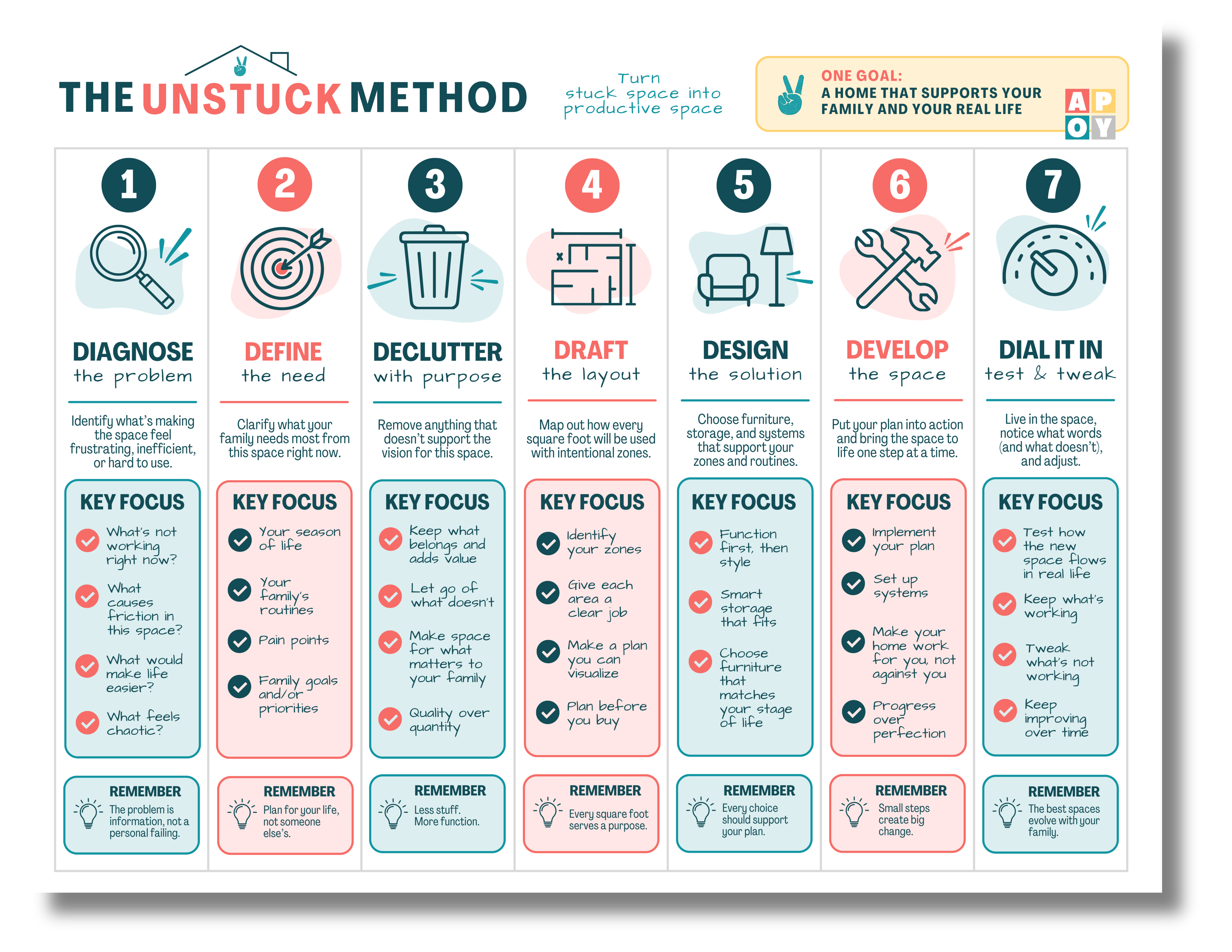
DOWNLOAD THE UNSTUCK METHOD GUIDE HERE
How I Organized Our Pantry to Work for Our Family
There are spaces in our homes that are messy, and then there are spaces that are stuck. A messy space might just need to be cleaned up or reset. A stuck space is different because it actively makes everyday life harder. For us, that space was our pantry.
Our pantry technically worked. The food was in there, the door closed, and we could find most things eventually. But every time I grocery shopped, packed lunches, made dinner, or sent one of my kids in to grab something, I was reminded that the pantry wasn’t actually working for our family. It was working against us.
That’s really the whole idea behind my Unstuck My Home series. I’m not trying to create a perfectly organized house or make every cabinet look Pinterest-worthy. I’m trying to identify the spaces and systems in our home that create unnecessary work and change them so they better support the way we actually live. Because when the everyday parts of running a home require less thought, less effort, and less management, they also require less of our mental capacity.
What Makes a Space “Stuck”?
I’ve started thinking about a stuck space as any area of our home that creates more work than it should. Maybe you constantly buy something you already have because you can’t see what’s in the pantry. Maybe putting away laundry takes forever because the drawers are too full. Maybe your kids ask you for a snack ten times a day because they can’t reach anything themselves. None of these things are major problems on their own, but when you’re dealing with them over and over again, they start taking up a surprising amount of your time and attention.
Our pantry had reached that point. It made grocery shopping harder because I couldn’t quickly see what we had or what we were running low on. It made cooking harder because ingredients weren’t stored in a way that made sense for how I actually prepared meals. It also didn’t support my kids’ independence because the things they regularly needed weren’t necessarily where they could easily see, reach, or put them away themselves.
Nothing about our pantry was catastrophic. It was simply inefficient. And I’ve realized that inefficiency repeated every single day can take up a whole lot more capacity than we give it credit for.
Your Home Should Work for You
I think it’s easy to approach organization as if the goal is to make our homes look organized. We buy matching bins, make pretty labels, line everything up, and hope we’ve finally solved the problem. And listen, I love a good bin. But a beautiful system that doesn’t make your life easier isn’t actually a very good system.
Your home should support your everyday life. The best pantry setup isn’t necessarily the one that looks best in a photo. It’s the one that makes grocery day easier, helps you see what needs to be restocked, makes throwing together dinner at 5:00 less frustrating, and allows your kids to grab the things they’re allowed to have without needing you every single time.
When I started looking at our pantry through that lens, I stopped asking, How can I organize this better? and started asking, What do I need this space to do for us? That small shift completely changes the purpose of organizing. Instead of creating a system for the sake of having a system, you’re creating one to solve actual problems in your everyday life.
Making Room for What Matters
Here’s the bigger reason I’ve become so invested in fixing these little inefficiencies around our house: we all have a certain capacity. I think of it like packing a suitcase. There’s only so much room in there, and chances are you’re going to fill it. But you get to decide what takes up that space.
When everyday responsibilities like laundry, meal planning, clutter, cleaning, grocery shopping, and home maintenance are bulky and inefficient, they take up way more room than they need to. You’re constantly remembering, deciding, searching, moving, reorganizing, asking, answering, and starting over. None of those individual moments feels particularly significant, but together they take up a lot of mental space.
When you simplify those things, you’re not trying to create an empty suitcase. You’re making room to pack the things you actually want to bring with you. For me, that’s homeschooling my kids, being creative, spending time with my family, and growing my business. I don’t want an emptier life. I want a full life. I just want it filled with the right things.
The Goal Isn’t Perfection. It’s Automation.
This has probably been the biggest mindset shift for me. I’m not organizing our home because I want it to stay perfectly organized. With kids living here, that would be a losing battle anyway. I’m creating systems because I want more parts of our home to run almost automatically.
I want to open the pantry and immediately know what we have. I want grocery shopping to require less guesswork. I want to start making dinner without digging through six different places for what I need. I want my kids to know where the things they use are and, just as importantly, where those things go when they’re done with them.
A good home system removes decisions from your day. Instead of repeatedly asking, Where should this go? Where is that? Do we have more? What do I need to buy? Can the kids reach it? The answers are built into the space. That’s the kind of organization I’m after. Not perfection, but automation. Every decision I don’t have to make about something I’ve already solved is a tiny bit of capacity I get back.
HOW I UNSTUCK OUR PANTRY
Instead of jumping straight into buying bins and moving things around, I worked through the pantry with one goal in mind: make this space work better for the way our family actually lives.
1. IDENTIFY THE FRICTION
First, I figured out exactly where the pantry was making life harder. What was I constantly searching for? What did I forget we already had? What made putting groceries away annoying? What were my kids always asking me to get for them? These little frustrations showed me what actually needed to change.
2. ORGANIZE AROUND OUR ROUTINES
Next, I thought about how we actually use the pantry instead of simply grouping things together because they belonged in the same category. The things I reach for while cooking needed to be easy to grab, everyday foods needed to be visible, and the items we use most needed the most convenient spots.
3. MAKE INDEPENDENCE EASY
Anything I wanted my kids to access on their own needed to be where they could see it, reach it, and understand the system. Creating kid-friendly zones means fewer “Mom, can you get me…” requests, and gives them more ownership over everyday routines.
4. GIVE BACKSTOCK A HOME
Extras needed their own designated space so I could quickly see what we already had before grocery shopping. No more buying another box of something only to discover three hiding in the back of the pantry.
5. MAKE THE SYSTEM OBVIOUS
Finally, everything needed a home that made sense to more than just me. Categories had to be simple enough that everyone could figure out where to find something and where to put it back. Because if I’m the only person who understands the system, I haven’t automated anything, I’ve just created another system that I have to manage.
Build Systems for the People Who Live There
The goal isn’t to avoid bins, baskets, or containers, it’s to choose ones that actually solve a problem in your space. Measure your shelves, think about what you need to store, and find organizers that make those items easier to see, access, and put away. A bin that perfectly fits your shelf and keeps a category contained can make a huge difference, but buying organizers just because they look good can sometimes create more work instead of less. Your pantry doesn’t need to look like someone else’s. It needs to function well for the people who use it every day.
A good system makes the desired action the easy action. If you want your kids to grab their own snacks, put appropriate snacks where they can reach them. If you want everyone to put things back, make categories obvious. If you want to stop overbuying, store extras somewhere visible instead of burying them behind other food. If you want meal prep to feel easier, organize ingredients around the way you actually cook.
Organizing your home shouldn’t give you more rules to follow. It should remove friction from the things you’re already doing.
Find Your Stuck Spaces
Your pantry might not be your stuck space. Maybe yours is the laundry room, the entryway, a bathroom cabinet, the playroom, the place where school papers pile up, or the kitchen counter that somehow collects seventeen completely unrelated objects by Tuesday. Instead of immediately asking how to make that space prettier, start paying attention to where you’re experiencing friction.
Notice what you’re constantly searching for, what you repeatedly have to remind everyone to do, what tasks take much longer than they should, and where you’re making the same decisions over and over again. Think about what your kids or other family members could potentially do independently if the environment made it easier for them. Those little frustrations are usually clues that you’ve found a system that isn’t working for you.
Sometimes the solution will be a full pantry overhaul. Other times it might be moving one basket to a lower shelf, getting rid of things you don’t use, creating one clear category, or changing where something lives. The point isn’t to organize everything. It’s to identify the things that are unnecessarily taking up your capacity and find a simpler way for them to work.
A Home That Gives You Capacity Back
The more I work through Unstuck My Home, the more I realize this series isn’t really about organization. It’s about building a home that supports the life happening inside of it. I don’t want to spend all of my capacity maintaining our house. I want our house to help me maintain our life.
That means creating systems that make repetitive tasks easier, give my kids more opportunities for independence, reduce unnecessary decisions, and allow more of our everyday routines to happen without me constantly managing them. Our pantry will absolutely get messy again, but there’s a big difference between a system that occasionally needs to be reset and a space that never really worked in the first place.
The goal isn’t perfection. The goal is automation.
Because when the everyday systems in our homes require less of us to function, we have more capacity for the things we actually want to fill our lives with. And that is what I’m trying to make room for.
THE METHOD BEHIND UNSTUCK MY HOME
The pantry is just one piece of a much bigger goal. Unstuck My Home is about identifying the spaces, routines, and systems that are creating unnecessary friction in your everyday life and finding practical ways to make them work better for you. If you want to dig deeper into the method behind this series—and learn how to spot the “stuck” areas in your own home, read my full Unstuck My Home method here. It’s the best place to start if you’re ready to create a home that requires less managing and gives you more capacity for everything else.



Hey There,
I’m Katelyn!

Hi, I’m Katelyn! Join me for creative, intentional family fun and practical home management tips! Parenting is hard, but I’ve got the tools to help you create a calmer, more intentional home!
BROWSE MY
TOY RECS
resourceS
SHOP LEARNING RESOURCES



Subscribe to the empty mug club

GET OUR DAILY TO-DOS FREE!
Plus, get the latest achievable learning activities, easy recipes, storage solutions, teacher-approved toy suggestions + exclusive discounts to Becoming You learning resources straight to your inbox!

About Katelyn Collier , MAT
Katelyn Collier is a former elementary school teacher turned homeschooling mom of three and the founder of A Pop of You. She’s passionate about helping families step away from the pressure of today’s fast-paced culture and create homes filled with presence, joy, and balance. Through her resources and podcast, she shares simple, practical tools to reclaim childhood and make family life feel lighter and more intentional.
Masters DEgree in elementary education
VOICE OF BECOMING UNPOPULAR, A PODCAST COMING SOON!
CREATOR OF BECOMING YOU, A KIDS’ LEARNING RESOURCE LINE


FIND MORE INSPIRATION
Even More Achievable Ideas