The Unstuck Method: A Better Way to Transform Any Space in Your Home
Most organizing advice starts with bins and baskets. The Unstuck Method starts with something more important: understanding why a space isn’t working in the first place. This free printable walks you through a simple 7-step framework to diagnose the problem, define your family’s needs, declutter with purpose, draft an intentional layout, design functional solutions, and create spaces that truly support your everyday life. Whether you’re tackling an entryway, playroom, pantry, or any other “stuck” space, this printable will help you think like a space planner, not just an organizer.

This blog post may contain affiliate links. When you make a purchase through these links, I may earn a small commission, at no additional cost to you. I only recommend products that I genuinely believe can benefit you and your family! Your support helps maintain and improve all things A Pop of You. Thanks so much!
DOWNLOAD THE UNSTUCK METHOD GUIDE HERE
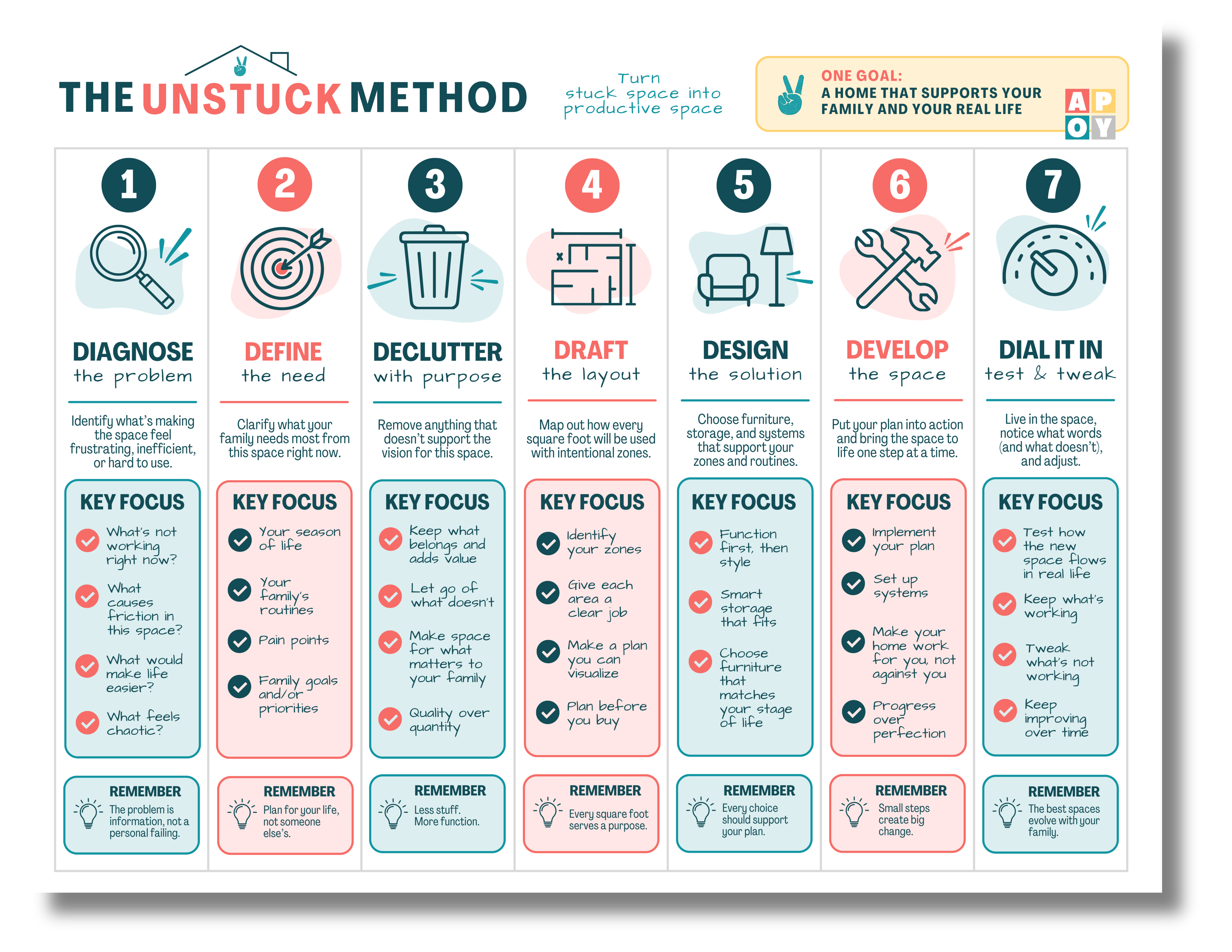
introducing The Unstuck Method
Most organizing advice starts with bins and baskets. The Unstuck Method starts with something more important: figuring out why a space isn’t working in the first place.
Because there are spaces in our homes that are messy, and then there are spaces that are stuck. A messy space might just need to be cleaned up or reset. A stuck space actively makes everyday life harder. It’s the entryway where no one knows where to put their shoes, the playroom that takes forever to clean because nothing has a real home, or the pantry where you keep buying things you already have because you can’t see what’s on the shelves.
None of these things are huge problems on their own, but when you’re dealing with the same little inefficiencies every single day, they start taking up a surprising amount of your time, energy, and mental capacity.
That’s why I created The Unstuck Method. Instead of asking, “How do I organize this?” I want to start with a better question: “Why isn’t this space working for us?”
Once you understand the problem, you can create a system that actually solves it.
YOUR HOME SHOULD WORK FOR YOU
I think it’s easy to approach organization as if the goal is to make our homes look organized. We buy the bins, make the labels, rearrange everything, and hope we’ve finally solved the problem. And listen, I love a good bin. But a beautiful system that makes your everyday life harder isn’t a very good system.
Your home should support the way your family actually lives.
That means the “best” solution isn’t necessarily the prettiest one or the one you saw someone else use. It’s the one that makes the desired action easier. It helps your kids become more independent. It gives frequently used things convenient homes. It makes it obvious where something belongs so everyone can help maintain the system.
The goal isn’t perfection. The goal is creating systems that require less of you to run. That’s what The Unstuck Method is designed to do. Here’s how it works.
let’s break down the Unstuck Method
step 1. Diagnose the Problem
Before you change anything, figure out what’s actually creating friction. What makes this space frustrating? What are you constantly searching for? What takes longer than it should? What do you repeatedly have to remind everyone to do? What are you constantly moving, rearranging, or cleaning up? Don’t worry about fixing anything yet. Just pay attention to the things that make you think, There has to be a better way to do this. Those little frustrations are usually clues to the real problem. If you skip this step and immediately start organizing, you may end up with a prettier version of the exact same problem.
step 2. Define the Need
Next, decide what your family actually needs the space to do. Think about your current season of life and the people who use the space every day. Maybe you need an entryway that allows three kids to independently put away their shoes and backpacks. Maybe you need a pantry that makes grocery shopping easier and puts snacks within reach. Maybe your playroom needs to make cleanup simple enough that your kids can actually do it themselves. Instead of organizing around what traditionally “belongs” in a space, organize around how your family needs to use it. Once you know the job of the space, it becomes much easier to decide what belongs there, and what doesn’t.
step 3. Declutter with Purpose
Decluttering isn’t just about owning less. It’s about making sure the things taking up valuable space actually support what you’re trying to accomplish. Now that you know what you need the space to do, look at everything that’s currently living there. Does it belong? Do you use it? Does it support the purpose you’ve defined for this space? Get rid of what no longer serves you, relocate things that would function better somewhere else, and take inventory of what’s left. You’re not trying to create an empty space. You’re making room for the things that actually need to be there.
Download the free Declutter Guide for simple prompts to help you clear the clutter with intention and make room for what actually belongs in your space.
GET YOUR DECLUTTERING GUIDE HERE

step 4. Draft the Layout
Before buying a single basket or moving furniture, decide how you want to use the space you have. Think about your everyday routines. What do you reach for most often? What should your kids be able to access independently? What needs to be visible? What can be stored higher or farther away? Where are you currently wasting valuable space? Give every area a purpose before you start filling it. This is where you stop trying to fit your life into an existing setup and start designing the setup around your life.
step 5. Design the Solution
Now we can talk about the bins. Once you know what you have, what the space needs to do, and where everything should live, you can choose storage, furniture, containers, or other solutions that actually support that plan. Measure your space and shop intentionally. Don’t buy an organizer and then try to figure out how to make it work. Find the organizer that solves the specific problem you’ve already identified. Sometimes the solution is a basket. Sometimes it’s a hook, shelf, drawer divider, or completely different piece of furniture. And sometimes the solution costs nothing at all, it’s simply moving something to a place that makes more sense. The products should support the system, not become the system.
step 6. Develop the Space
Now it’s time to bring the plan to life. Give everything a home, not a random open spot or wherever it happens to fit, but an intentional place based on what it is, how often it’s used, and who needs to access it. A good home system makes the desired action the easy action. If you want your kids to put their shoes away, the place for their shoes needs to be somewhere they can easily reach. If you want everyone to help clean up the playroom, toy categories need to be simple enough for everyone to understand. And if you’re the only person who understands where everything belongs, you haven’t really automated anything. You’ve just created another system that you have to manage.
step 7. Dial It In
No system is going to be perfect on day one. Live with it for a while. Pay attention to what naturally stays organized and what keeps falling apart. If everyone keeps putting something in the “wrong” place, maybe that’s actually a clue that the wrong place makes more sense. Your systems are allowed to change as your family changes. The goal isn’t to organize a space once and never touch it again. The goal is to create a system that’s easy to maintain and even easier to reset because everything already has somewhere to go.
WHY THIS MATTERS: YOUR CAPACITY
Here’s the bigger reason I care so much about making our home more efficient: we all have a certain capacity. I think of it like packing a suitcase. There’s only so much room in there, and chances are, you’re going to fill it. But you get to decide what takes up that space.
When everyday things like laundry, meal planning, clutter, cleaning, grocery shopping, and home maintenance are bulky and inefficient, they take up more room than they need to. You’re constantly remembering, deciding, searching, moving, reorganizing, asking, answering, and starting over.
Simplifying those things doesn’t give you an empty suitcase. It gives you more room to pack the things you actually want to bring with you. For me, that’s homeschooling, creativity, family time, and building a business. For you, it might look completely different.
The goal isn’t an emptier life. It’s a life filled with the right things.
CREATE A HOME THAT GIVES YOU CAPACITY BACK
Ultimately, The Unstuck Method isn’t really about organization. It’s about creating a home that supports the life happening inside of it. You don’t need your home to look like someone else’s. You don’t need every cabinet perfectly organized or every basket perfectly labeled. You need systems that work for the people who actually live there.
Start with one space that’s creating friction. Diagnose what’s not working. Decide what you need instead. Then build a system around your real life, not an idealized version of it.
The goal isn’t perfection. The goal is automation. Because when the everyday systems in your home require less of you to function, you get some of that capacity back for everything else you actually want to fill your life with.
Ready to get started? Download the free Unstuck Method Guide and use the 7-step framework to tackle the next space in your home that feels a little…well…stuck.
DOWNLOAD THE UNSTUCK METHOD GUIDE HERE

Hey There,
I’m Katelyn!
Hi, I’m Katelyn! Join me for creative, intentional family fun and practical home management tips! Parenting is hard, but I’ve got the tools to help you create a calmer, more intentional home!
BROWSE MY
TOY RECS
resourceS
SHOP LEARNING RESOURCES


Subscribe to the empty mug club

GET OUR DAILY TO-DOS FREE!
Plus, get the latest achievable learning activities, easy recipes, storage solutions, teacher-approved toy suggestions + exclusive discounts to Becoming You learning resources straight to your inbox!

About Katelyn Collier , MAT
Katelyn Collier is a former elementary school teacher turned homeschooling mom of three and the founder of A Pop of You. She’s passionate about helping families step away from the pressure of today’s fast-paced culture and create homes filled with presence, joy, and balance. Through her resources and podcast, she shares simple, practical tools to reclaim childhood and make family life feel lighter and more intentional.
Masters DEgree in elementary education
VOICE OF BECOMING UNPOPULAR, A PODCAST COMING SOON!
CREATOR OF BECOMING YOU, A KIDS’ LEARNING RESOURCE LINE


FIND MORE INSPIRATION
Even More Achievable Ideas