How to Build Number Sense: Activities from Number Recognition to Addition
Turn one simple number activity into a learning tool that grows with your child! Learn how to use Flip & Find to intentionally build number recognition, counting, one-to-one correspondence, number sense, and early addition and subtraction skills.

This blog post may contain affiliate links. When you make a purchase through these links, I may earn a small commission, at no additional cost to you. I only recommend products that I genuinely believe can benefit you and your family! Your support helps maintain and improve all things A Pop of You. Thanks so much!
How to Teach Numbers: From Recognition to Counting to Addition
When we think about teaching numbers, it’s easy to think the progression is simply learning bigger numbers. First 1–10, then 1–20, then 1–50. But learning numbers isn’t just about how high your child can count. It’s about what they actually understand about those numbers.
Can they recognize a number when it isn’t presented in order? Do they understand that the numeral 8 represents eight actual objects? Can they accurately count a group using one-to-one correspondence? Eventually, can they use those numbers to add, subtract, compare, and solve problems?
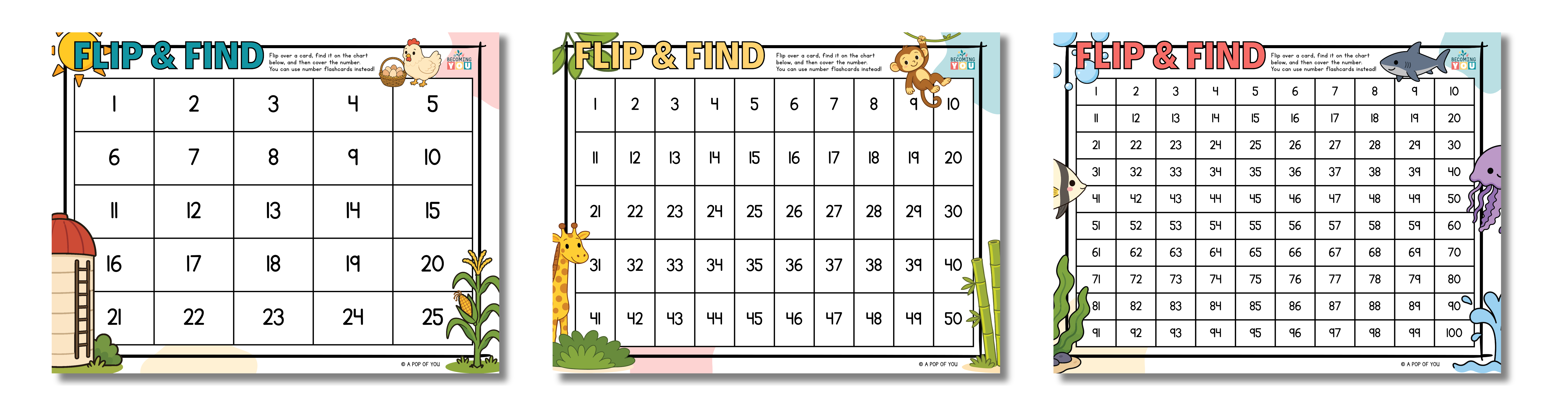
That’s why I love activities like Flip & Find. At its simplest, Flip & Find is a hands-on number recognition activity: flip a number, identify it, and find the matching number on the board. But you don’t have to ditch the activity once number recognition is mastered. In fact, you can use the same 1–25 Flip & Find board to practice multiple stages of early math development. The resource stays simple while the skill you’re practicing grows with your child.
Below, I’m breaking number learning into three levels: Recognize, Understand and Apply, so you can confidently and intentionally use Flip & Find based on what your child is actually ready to learn.
Understanding the Progression of Number Learning
Knowing numbers isn’t one skill. It’s a collection of skills that build on one another. A child might be able to count aloud to 20 because they’ve memorized the sequence but not recognize the numeral 14 when it’s shown independently. Another child might recognize 14 immediately but struggle to accurately count out 14 objects.
Eventually, children need to connect all of those skills so numbers become more than symbols they’ve memorized. They begin to understand what numbers represent, how quantities relate to one another, and eventually how numbers can be combined and separated to solve problems.
For early learners, I like to think about that progression in three broad stages: Recognize, Understand and Apply.

Learning Goal: I can recognize, name, and match written numbers.
Number recognition is one of the foundational skills of early math. Before children can meaningfully add, subtract, or work with quantities, they need to understand that the symbols we write represent specific numbers. This is where the traditional version of Flip & Find comes in. Have your child flip a number card, identify the numeral, and find the matching number on the board: Flip 7 → Say “seven” → Find 7.
Simple? Absolutely. But there’s a lot of valuable learning happening. Your child is practicing number recognition and naming, visual discrimination, matching identical numerals, recognizing numbers out of sequence, and becoming more familiar with numbers that aren’t yet automatic.
That last piece is especially important because children often learn to count numbers in order before they can recognize them independently. They may happily rattle off “11, 12, 13, 14, 15…” but when you show them 14 by itself, they aren’t sure what it is. Flip & Find removes the predictable counting sequence and asks children to recognize each numeral on its own, helping move them from simply memorizing the order of numbers to actually identifying the symbols that represent them.
How to Teach It
When introducing Flip & Find, I like to use an I Do, We Do, You Do approach. First, model exactly what you want your child to do: “I flipped the number 12. This is twelve. Now I’m going to look around my board until I find another 12.” Then complete a few turns together before gradually stepping back and allowing your child to flip, identify, and find the numbers independently.
And if your child doesn’t know a number? Tell them. The goal here is to teach, not quiz. Instead of repeatedly asking, “What number is this?” when they clearly don’t know, say, “This is 17. Can you find another 17 on your board?” They’re still hearing the number name, visually studying the numeral, and searching for its match. As that connection becomes stronger, you can gradually remove your support.
You also don’t need to wait until your child can perfectly identify every number from 1–25 before introducing another skill. Look for growing confidence and independence. If they’re recognizing most numbers without much thought and the original activity is beginning to feel easy, start layering in some next-level number skills.

Learning Goal: I understand that a number represents a specific quantity.
Recognizing the numeral 8 is one skill. Understanding that 8 means eight actual things is another. This is where we move beyond simply identifying numbers and begin building a deeper understanding of what those numbers represent.
You can continue using the exact same 1–25 Flip & Find board, but instead of stopping once your child identifies and finds the number, ask them to represent its quantity. If they flip an 8, they might identify 8, find 8 on the board, and then count out eight objects. Grab whatever you already have nearby, counting bears, blocks, pom-poms, buttons, counting ducks (my personal favorite!), counting bears, or even snack pieces. The specific manipulative doesn’t matter nearly as much as the act of connecting the written numeral to a physical amount.
As your child counts, encourage them to touch or move one object for every number they say. This develops one-to-one correspondence, or the understanding that every object being counted receives one, and only one, number word. It may seem straightforward to us, but young children often point faster than they count, count the same object twice, skip an object, or continue saying numbers after they’ve run out of objects. Physically moving each object as they count helps make the process much more concrete.
Once they finish counting, ask one more simple question: “So, how many do you have?” We want children to understand that the final number they said represents the total number of objects in the group. This concept is called cardinality, and it’s another important part of developing number sense. We’re moving from I know how to say numbers in order to I understand that the number 8 represents this entire group of eight objects.
As your child becomes more confident, you can use the same board to explore number relationships, too. Flip two numbers and ask which is greater or smaller, which would represent more or fewer objects, or have your child build both quantities and compare them. You can also flip one number and ask what comes before it, what comes after it, or have your child begin counting from that number instead of always starting at one.
You don’t need to do all of these things every time you pull out Flip & Find. In fact, I wouldn’t. Choose one specific skill you want to reinforce and make that the focus. The goal is intentional practice, not squeezing every possible math concept into one activity.

Learning Goal: I can use numbers to solve problems.
Once your child can confidently recognize numbers and connect those numerals to quantities, that same little 1–25 board can become a tool for practicing early addition and subtraction. You still don’t need a different board or a more complicated printable. Instead, you simply change what your child is asked to do with the numbers.
For addition, flip two number cards that create a sum within the range of the board. If your child flips a 6 and a 3, they can solve 6 + 3 and then find 9 on the board. For a child who is new to addition, keep it concrete. Have them count out six objects, count out three more, push the groups together, and count how many there are altogether. They’re physically seeing what addition means, putting quantities together, before finding the answer on the board.
You can do the same thing with subtraction. Flip two numbers, place the larger number first, and subtract the smaller number. If your child flips 12 and 5, they can solve 12 – 5 and find 7 on the board. Again, manipulatives can make the concept concrete: count out 12 objects, take away 5, count what remains, and then find the answer.
The board can also be used to explore composing and decomposing numbers, which is an important foundation for later mental math. Flip one number, say 10, and ask your child to think of different ways to make it. They might discover that 5 + 5, 6 + 4, 7 + 3, and 9 + 1 all make 10. Using manipulatives to physically separate ten objects into different groups allows them to see that the same total can be made in multiple ways.
And don’t be in a hurry to take those manipulatives away. Being ready for application skills doesn’t mean a child should be expected to do everything mentally. Physical objects allow children to see the math they’re doing, building concrete understanding before expecting abstract thinking. As their number sense becomes stronger, they’ll naturally begin solving some equations without needing to physically build every quantity first.
The Board Isn’t Getting Harder. The Thinking Is.
This is one of the biggest things I want parents to take away from Flip & Find: you don’t always need a more advanced resource as your child learns. Sometimes you just need to know how to use a simple resource more intentionally.
As your child moves through these developmental steps, the way they use the activity grows with them. In the Recognize step, they might flip 8, identify it, and find 8. As they move into Understand, they can flip 8, recognize it, and count out eight objects, connecting the numeral to its quantity. And when they’re ready to Apply what they know, they might flip 5 and 3, solve the equation, and find 8.
It’s the exact same board, but the level of thinking is completely different. That’s why understanding the learning goal behind an activity matters just as much as having the activity itself.
How to Choose the Right Level for Your Child
Don’t choose where to begin based solely on your child’s age or grade. Instead, start with what they can do confidently and independently. If your child is still learning to recognize and name written numerals or relies heavily on counting in sequence to identify them, focus on Recognize. If they recognize most numerals but need practice connecting them to quantities, accurately counting objects, or using one-to-one correspondence, begin building Understand skills. Once they confidently recognize numbers, represent their quantities, and are ready to combine and separate those quantities, you can begin introducing opportunities to Apply what they know.
These developmental steps aren’t rigid, and children will often move between them depending on the number or skill they’re working with. Your child might independently recognize numbers 1–10 but need more support with 11–25. Or they may be beginning addition while still benefiting from counting out physical quantities when a problem feels tricky. Recognize, Understand, and Apply are meant to build on one another, not replace one another.
That’s all useful information about where your child is in their learning. The goal isn’t to move through the progression as quickly as possible. It’s to recognize what your child understands now and give them intentional opportunities to strengthen that understanding and build on it.
How to Use Flip & Find Intentionally Without Making It Complicated
You don’t need to turn a simple printable into a 30-minute math lesson to make it educational. Before you begin, decide on the one skill you want to practice that day. Maybe today you’re focusing on number recognition. Tomorrow you’re practicing one-to-one correspondence. Later in the week, you might use the same board for simple addition within 10.
Five or ten intentional minutes practicing one skill can be incredibly valuable. Flip & Find can be pulled out during your morning routine, added to a homeschool math rotation, used while you’re working one-on-one with another child, or simply set out when you want a quick hands-on learning activity.
The printable gives you the structure. Understanding the skill you’re targeting is what turns it into a true learning tool.

Keep the Number Learning Going
Once your child is ready to build on the skills practiced through Flip & Find, you can continue the progression with other hands-on activities. Baby Wipe Top Count & Drop is a natural next step for children working at the understand level because it strengthens number value, counting, and one-to-one correspondence. Children identify a number and physically count the corresponding quantity, giving them additional practice connecting the numeral they see with the amount it represents.

For children moving into application skills, Egg Carton Addition takes those counting and quantity skills and applies them to simple single-digit addition. Using counting ducks and an egg carton allows children to physically build the two parts of an equation and combine them to find the total, helping bridge the gap between understanding quantities and solving written equations.

One Simple Activity, A Whole Lot of Learning
The goal of early math isn’t to see how quickly we can get children to addition. It’s to build the understanding underneath it. Children first need to recognize numbers and then understand that those numbers represent actual quantities. They need opportunities to count accurately, practice one-to-one correspondence, compare amounts, and explore how numbers relate to one another. Eventually, they can begin putting those quantities together and taking them apart.
That’s the progression I want Flip & Find to support: recognize it, understand it, and apply it.
And sometimes, all three can start with the exact same 1–25 Flip & Find board.



Hey There,
I’m Katelyn!

Hi, I’m Katelyn! Join me for creative, intentional family fun and practical home management tips! Parenting is hard, but I’ve got the tools to help you create a calmer, more intentional home!
BROWSE MY
TOY RECS
resourceS
SHOP LEARNING RESOURCES


Subscribe to the empty mug club

GET OUR DAILY TO-DOS FREE!
Plus, get the latest achievable learning activities, easy recipes, storage solutions, teacher-approved toy suggestions + exclusive discounts to Becoming You learning resources straight to your inbox!

About Katelyn Collier , MAT
Katelyn Collier is a former elementary school teacher turned homeschooling mom of three and the founder of A Pop of You. She’s passionate about helping families step away from the pressure of today’s fast-paced culture and create homes filled with presence, joy, and balance. Through her resources and podcast, she shares simple, practical tools to reclaim childhood and make family life feel lighter and more intentional.
Masters DEgree in elementary education
VOICE OF BECOMING UNPOPULAR, A PODCAST COMING SOON!
CREATOR OF BECOMING YOU, A KIDS’ LEARNING RESOURCE LINE


FIND MORE INSPIRATION
Even More Achievable Ideas